Like a balanced diet focuses on the right mix of nutrients required for your appetite, an asset allocation consists of the right mix of different asset classes for your risk appetite.
Why is it necessary to allocate your assets?
These allocations are proportionate to the stage of life you are in. Many investors don’t consider risks and returns. Hence, they end up having portfolios that are heavily skewed and irrational towards particular asset classes.
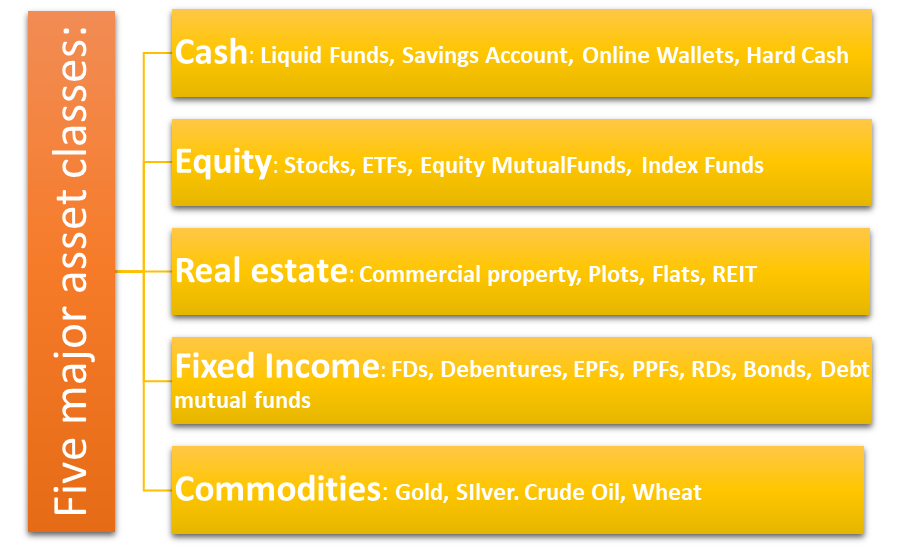
Here are the asset classes and requirements they fulfill in a portfolio:
Asset Class
Features in a portfolio
Cash
High liquidity, prone to inflation
Bonds/ Fixed Income
Safe income, mediocre returns
Equity
High growth
Gold/ Commodity
To hedge risks
Real Estate
Immune to inflation but low liquidity
Virtual Assets
Novel investment avenue, extremely high risk and volatility
Though the investment decision varies for every individual and their financial goals and needs, here are some general suggestions that you can consider before allocating your assets. The segment divides basic asset classes according to your age:
Age
20s
30s
40s
50s
60s - 70s
Risk Tolerance
Very high
High
Medium
Low
Very low
Approach towards risk
Aggressive;
80% equity & 20% bonds
Can afford risk; 70% equity & 30% bonds
Moderate; 60% equity & 40% bonds
Safe; 40% equity & 60% bonds
Can’t afford risk; 25% equity & 75% bonds
Features
Time availability with better compounded returns
Income stability
Peak earning potential but not enough time to take risks
Less miscellaneous expense and more health expenses
Collect retirement benefits and keep a steady portfolio
Financial goal
To invest long term, create emergency funds, pay debts, and avoid slow-growing assets
Retirement and health contribution are priority
To invest in inflation-beating assets
Have 3-6-month emergency funds, switch to stable low earning funds in money markets
Safeguard the corpus received and focus on consolidating investments
To understand the allocation better, you can apply a classic thumb rule. Subtract your age from 100. Invest the difference as a percent of your savings into equities and the rest percentage in bonds. For example, Raman’s age is 25. He saves Rs 30,000 every month. According to the thumb rule, he should invest 75%, i.e. Rs. 22.5k, of his savings to equity/ stocks and 7.5k into bonds.